Queer “Selkies” and Appalachian Belonging
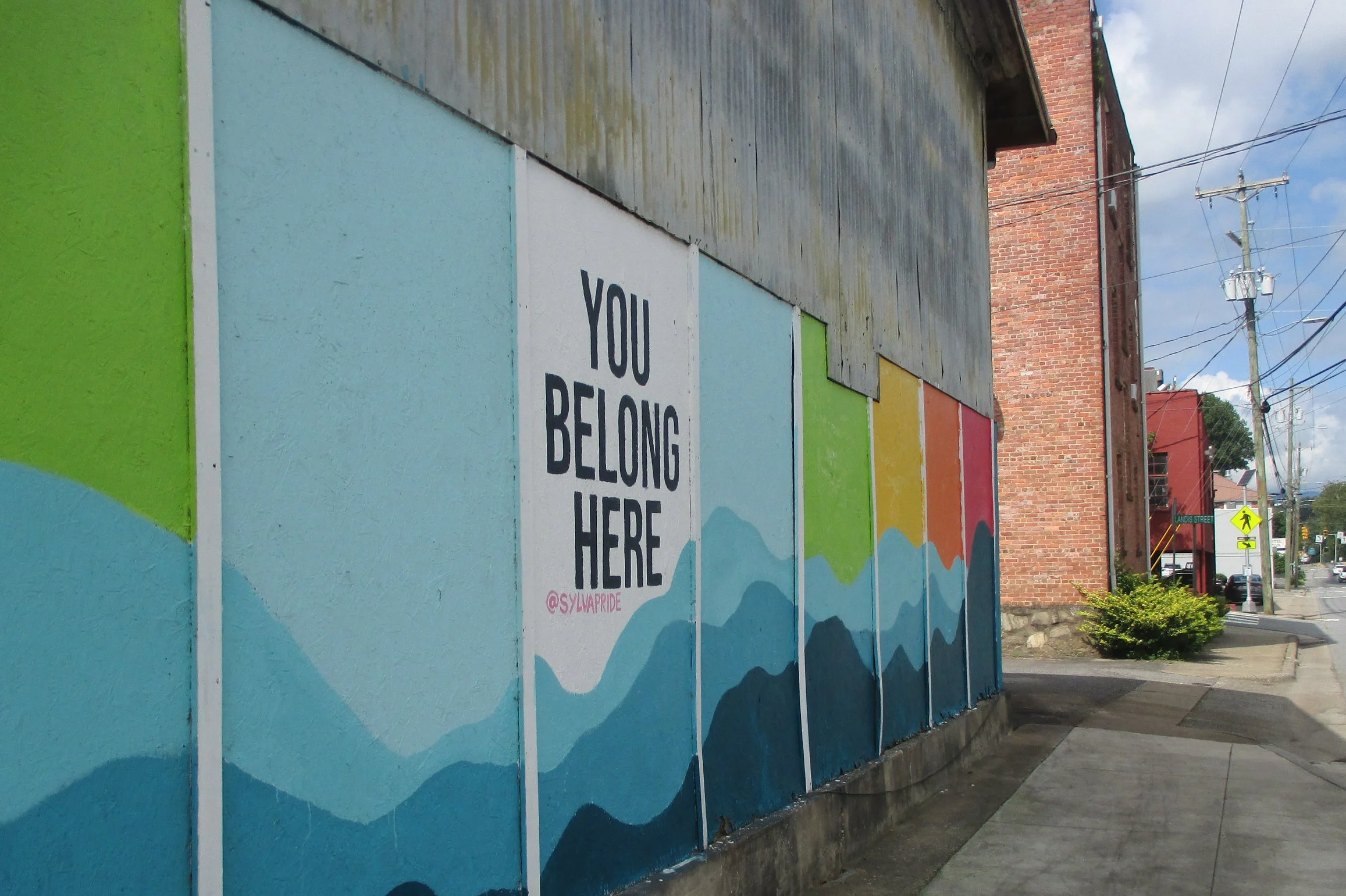
Pride mural, as seen in downtown Sylva, North Carolina.
In a 1999 article by Jeff Mann in the Journal of Appalachian Studies called “Stonewall and Matewan: Some Thoughts on Gay Life in Appalachia,” he compares queer existence in Appalachia to that of the selkie from Scots-Irish folklore. In folklore, a selkie is a creature that can shift between a land-dwelling human form and a sea-dwelling seal form by donning and shedding their seal’s skin and thus are “…perhaps not entirely at home in either world.”[i] Are queer Appalachians truly like selkies, with the capacity to blend into separate environments but forever blocked from embracing some nebulous true form? Primary accounts illustrate some truth to this proposition, but as history has developed, the progress made by queer Appalachians in their quest for self-discovery and social acceptance has brought them ever closer to the middle ground between land and sea.
Queer people have historically gone unnoticed in Appalachia, much in the way that Appalachia is sidelined from the rest of the nation. Additionally, it is important to realize that in much of the work on Appalachia, “Appalachian” usually means by default people living in the Appalachian region of a European background unless an author claims otherwise. However, in the past three decades, scholarship combining the fields of Appalachian history and queer history has emerged. Queer history is decisively a topic of social and cultural history—the restrictions that are applied to queer people exist because of social constructions, so it only makes sense. Unfortunately, because of queer history’s status as a topic of sociocultural history and the additional complexity added by considering queer people in the Appalachian region, it’s difficult if not impossible to trace a clean line through the historiography of the past 30 or so years where there has been more concentrated work by queer historians. Thus, instead of looking for this nonexistent historiographical thread, it is instead necessary to read for the overall development of uniting themes like self-determination, community building, and collective memory.
Kate A. Black and Marc A. Rhorer’s 1995 article “Out in the Mountains: Exploring Lesbian and Gay Lives” is an excellent essay interweaving interviews that highlight different thematic aspects of the queer Appalachian experience, like isolation, family and kinship, or internalized homophobia. By interpreting the interviews they conducted collectively, Black and Rhorer effectively build upon these themes and draw strong connections that illustrate the deep complexity of queer Appalachian lives and how they are especially affected by a cultural focus on kinship and community in the church. Of this, they write that “[h]omophobia is not only perpetuated by those who dominate, but it is also internalized by those who are dominated… many [people had] deep inner struggles over their sexualities, rooted in deep religious notions of sin and guilt.”[ii] This internal divide shapes the lives of countless queer Appalachians. Jeff Mann is not a historian, but his essays detailing his intensely emotional experiences and thoughts about his ties to the mountain South touch on similar themes. In many anthologies that primarily detail the academic challenges of researching queer Southerners and social issues that plague queer Appalachians, Mann’s work is featured as an example of the contradictions and fissures a queer Appalachian must mend to return home. To Mann, Appalachia as a queer person too often becomes a place of “…divided loyalties, divided identities, and despair.”[iii] A line he writes about his eventual return to Appalachia is useful to keep in mind when reading stories of other Appalachians who left the region but were then called home, despite still feeling a rift between their identity and their home community, because of how well he illustrates the feeling. Of this emotional experience, he writes that “[f]or that young man I was, weeping on a city rooftop, pining for a mountain home so eagerly left, longing was less a direction and more a damnation, the fear that I belonged nowhere.”[iv]
Many Appalachians articulate feeling a unique connection to the land, and queer Appalachians are no exception. In Mary Anglin’s 1997 article “Aids in Appalachia: Medical Pathologies and the Problem of Identity,” she returns consistently to the idea of borderlands—or, the cultural delegation of Appalachians with HIV/AIDS to a societal borderlands while they already exist in the larger borderlands that is Appalachia.[v] In the social mesh of smaller Appalachian communities, there is a complex net of loyalties and kinship ties to reckon with, or, as Anglin presents it, borders to be crossed.[vi] Considering the development of Appalachia’s culture is essential to her discussion of the ways Appalachians with AIDS have been ostracized and the challenges they face, especially in regard to the outside perceptions of an Appalachian monolith that have further hurt the opportunities sick Appalachians have to receive help. Anglin writes of the pushback to the dominant perception of Appalachia’s culture and sexual demographic makeup that “Appalachia is thus neither to be seen as authentic culture populated by the descendants of the ‘original mountain men,’ nor as a backwater of fear and loathing. In this rendering Appalachia is a place where homosexuals, heterosexuals, and people of indeterminate sexual identities have lived among the contradictions of sexism, homophobia, and tolerance.”[vii]
The idea of borderlands doesn’t have to refer to geography alone. In Carrissa Massey’s 2007 article “Appalachian Stereotypes: Cultural History, Gender, and Sexual Rhetoric”, she examines the persistent cultural othering of Appalachians for reasons like race, class, or gender, all ideas that might fall into the common name of the “Appalachian other.”[viii] Although her article isn’t about queer expressions and instead is about the boundary pushing of traditional gender roles and expressions as applied to Appalachians by journalistic and fictional media like the Beverly Hillbillies or the Dukes of Hazzard, her work is still immensely useful from the standpoint of queer Appalachian history. Because much of her analysis focuses on the hypersexuality and bastardization of femininity and joint weakening of masculinity as applied by such cultural productions, it is easy to apply her work to the gender stereotypes often applied to queer identities, like the overly feminine gay man or the overly masculine lesbian woman.
Mary Gray is highly significant to the topic of queer Appalachian history and is cited by almost every author that comes after her work chronologically. She contradicts the dominant historiographical trends that leave out Appalachia in discussions of queer southerners, likely because of her explicit rural scope. In her 2009 book Out in the Country: Youth, Media, and Queer Visibility in Rural America, she gets at the heart of the dissonance between queer community building in Appalachia versus the rest of the national gay rights movement. She argues that rural communities are not inherently hostile to queer community and identity like many might think, and it is instead that the strategies and metrics of visibility and belonging as dictated by a largely urban, middle-class national gay rights movement do not reflect the differing needs and structures of rural communities and the queer people who call them home.[ix] It isn’t a flat resistance to queer people—contrarily, many queer people historically have lived in small Appalachian communities for their whole lives with little fanfare, existing in a space between being closeted and being out-and-proud that allowed them to keep their space in their existing non-queer community spaces. This makes sense as an argument when compared to other themes of Appalachian history—considering the broad and not entirely positive and progressive changes wrought by the influence of outside or affluent people in the name of capitalistic progression, it’s easy to ascertain that rural Appalachians whose communities were likely forever altered by this encroachment might have reason to be resistant to outside influences, even in the pursuit of queer acceptance. Rural locations and low financial mobility create strong social ties within rural Appalachian communities, but Gray notes that these strong social and kinship networks also come with a dominant traditional family-first attitude that resists change.[x]
Considering the sparse literature dedicated to queer Appalachians alone, it begs the question—how can someone exist in the margins of an already othered place? How do queer Appalachians contradict isolationist narratives? Despite intense societal pressure and overwhelming odds, queer Appalachians have historically built communities and sustained their survival in the mountains that call them home. Four themes encapsulate the experiences of queer Appalachia—geographical attachment, religious emotion, community, and sense of belonging.
LONGING FOR DAMNATION: QUEER APPALACHIAN DIASPORA AND THE HOLLER
Diasporic queer Appalachians can feel overwhelming cultural ties to their Appalachian homes. Geographically, Appalachia is indeed a borderland, set apart by the Appalachian Mountains, and queer people who feel isolated from both their home communities and the communities they migrate to can connect with this natural perceived geographic isolation. Rural Appalachia provided a place for radical spiritual coalitions like the Radical Faeries. The memory of environmental exploitation weighs heavy on Appalachia, and the treatment of the environment and historical ways of land use can play into the attitudes towards queer people in the hollers. In reference to the AIDS crisis that started in the 1980s and quickly pervaded America, some people argued that it was divine wrath. God had left the deadly virus in the hollows that once held coal.[xi]
SUFFERING AND SALVATION: SANCTUARY IN THE CHURCH
For queer Appalachians, the church can be at once a place of suffering and of salvation. Churches are almost as present in the Appalachian Mountains as the trees, and even if one isn’t connected to the religious aspect, churches have still historically been a place of gathering and community for Appalachian people. Queer Appalachians are also likely to forgo Christianity in favor of other forms of spirituality. For queer Appalachians, the church is a double-edged sword—as long as they hide their queerness, they can remain a valued part of their church community, but as soon as their identity is overt, they can be ostracized overnight.[xii][xiii] However, churches can also welcome queer people with open arms, and church AIDS coalitions across Appalachia have often played vital roles in the effort to relieve those afflicted with HIV/AIDS.[xiv]
BUILDING BRIDGES: COMMUNITY AS IF ON THE PORCH
In small towns, queer people grew to rely on intricate and subtle means of community-building. From lesbian-dominated softball leagues to e-mail correspondence, gay Appalachians moved in secret to form vital social networks of like spirits.[xv] Activism and outreach provides a vital queer social space, regardless of if the fight for progress will be ultimately fruitless.[xvi] By breaching the boundaries of public visibility at risk of their own safety, queer Appalachians create an Appalachia where they have stronger communities of queer peers to connect with and where, unlike their forebearers, they do not have to hide their queerness in their communities in order to be a member of them.
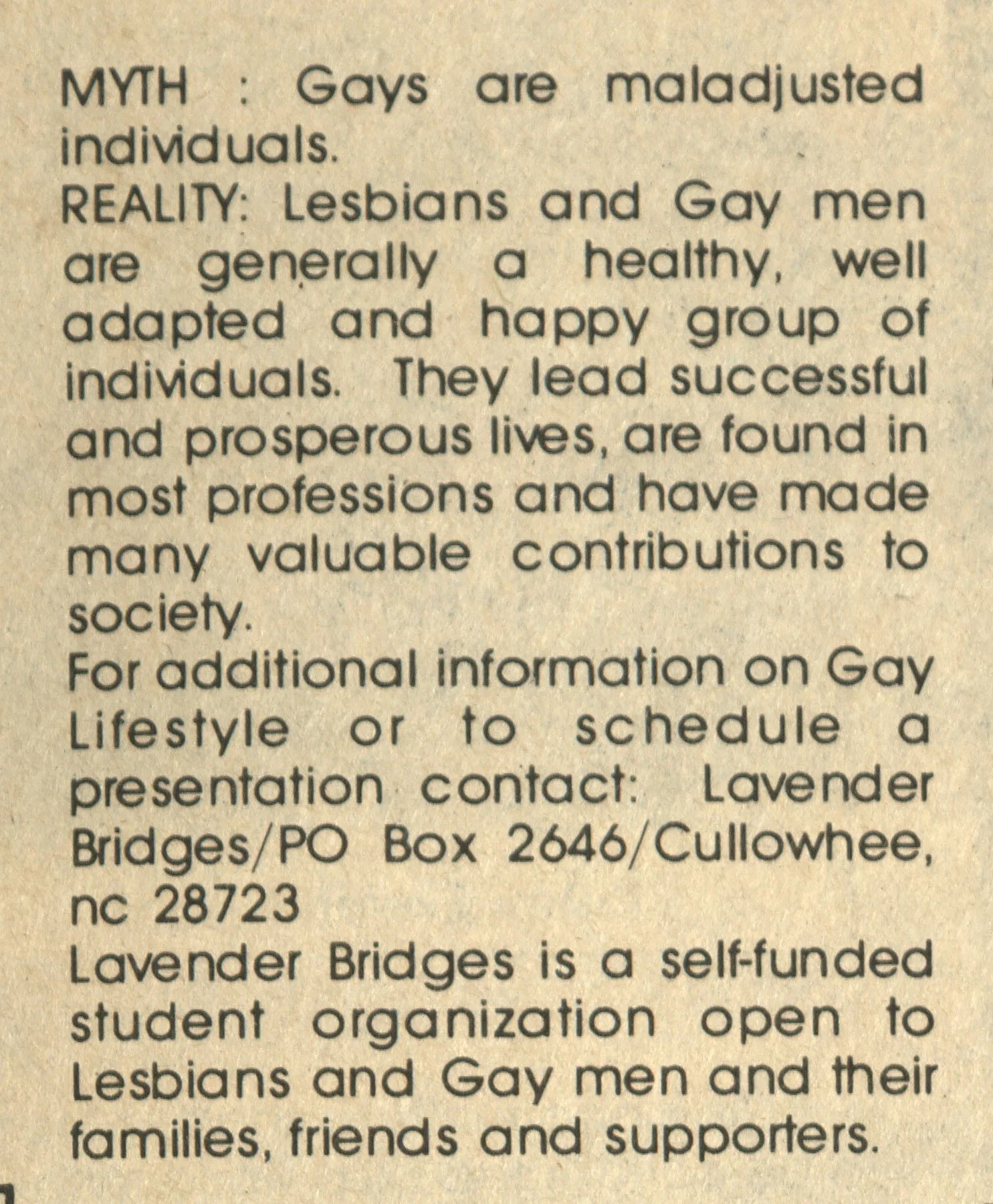
Advertisement in a 1986 issue of The Western Carolinian, student newspaper of Western Carolina University.
Courtesy of Southern Appalachian Digital Collections.
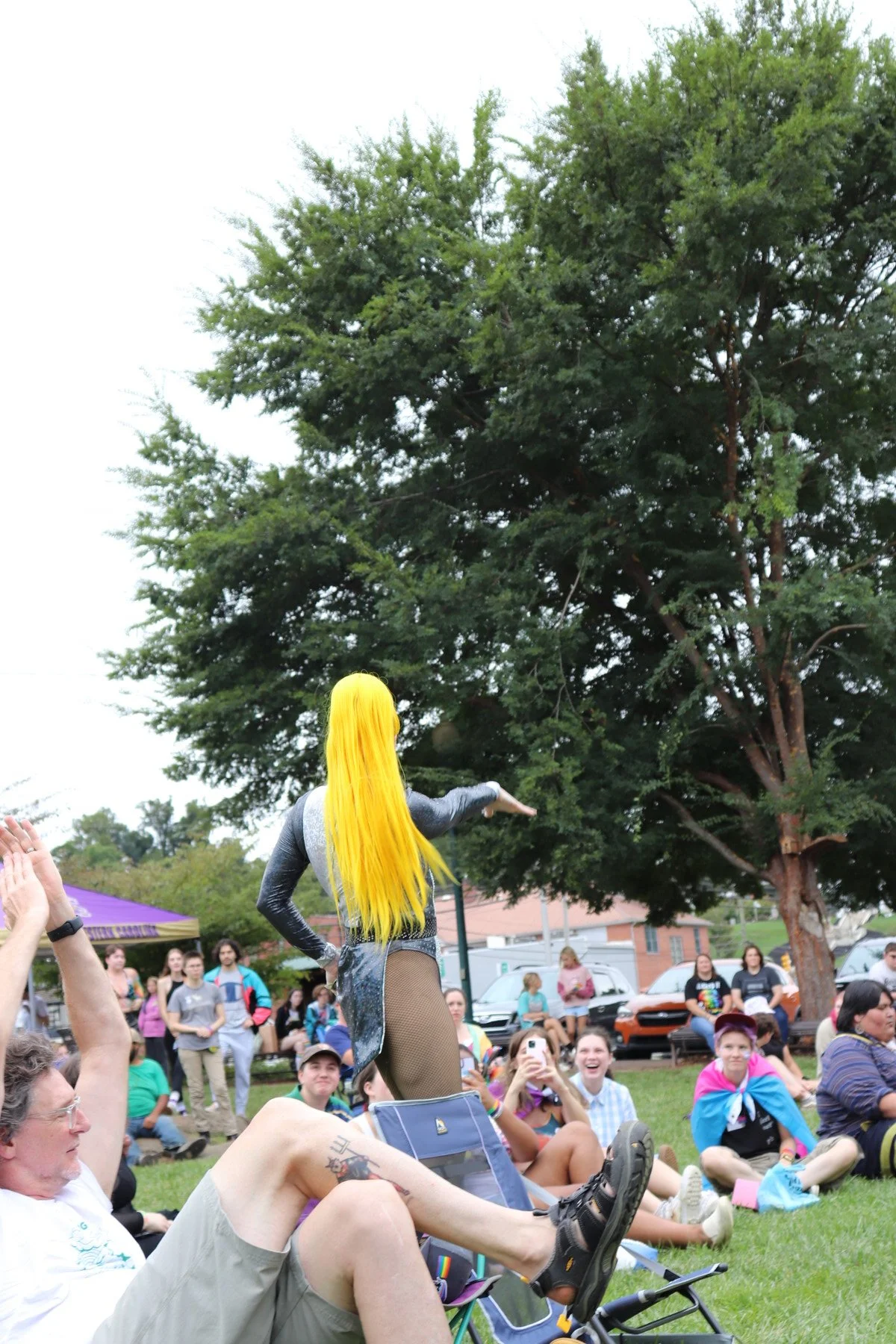
Drag queen Calcutta performing at Sylva Pride, 2022.
Courtesy of Southern Appalachian Digital Collections.
THE LODESTONE SOUTH: A MAGNETIC PULL HOME
As a young man, gay author and poet Jeff Mann chose to leave the South for what he thought was the greener pasture of the American West. He mourned the trappings of the Appalachian home, culinary and culturally, writing of homemade biscuits and lazy Sundays after church that “[t]his is the South from a distance, distance that allows out-of-focus forgetfulness…it’s taste is sweet again, the flavor of nostalgia.”[xvii] Home is both a place and a feeling, and many queer Appalachians feel they are denied home in both its forms. As they reach adulthood and independence, queer Appalachians are faced with a choice—leave the mountains for the perceived belonging of queer city centers elsewhere, or stay with the people they know and feel forever slightly out of place? There is no right answer, and many queer Appalachians still feel unmoored. Queer Appalachians must decide for themselves how to reckon with both their queerness and their place as mountain people. Mann continues in his rumination that “[t]his is the lodestone South, that pulls you home against your reason to a place where you can never entirely belong.”[xviii]
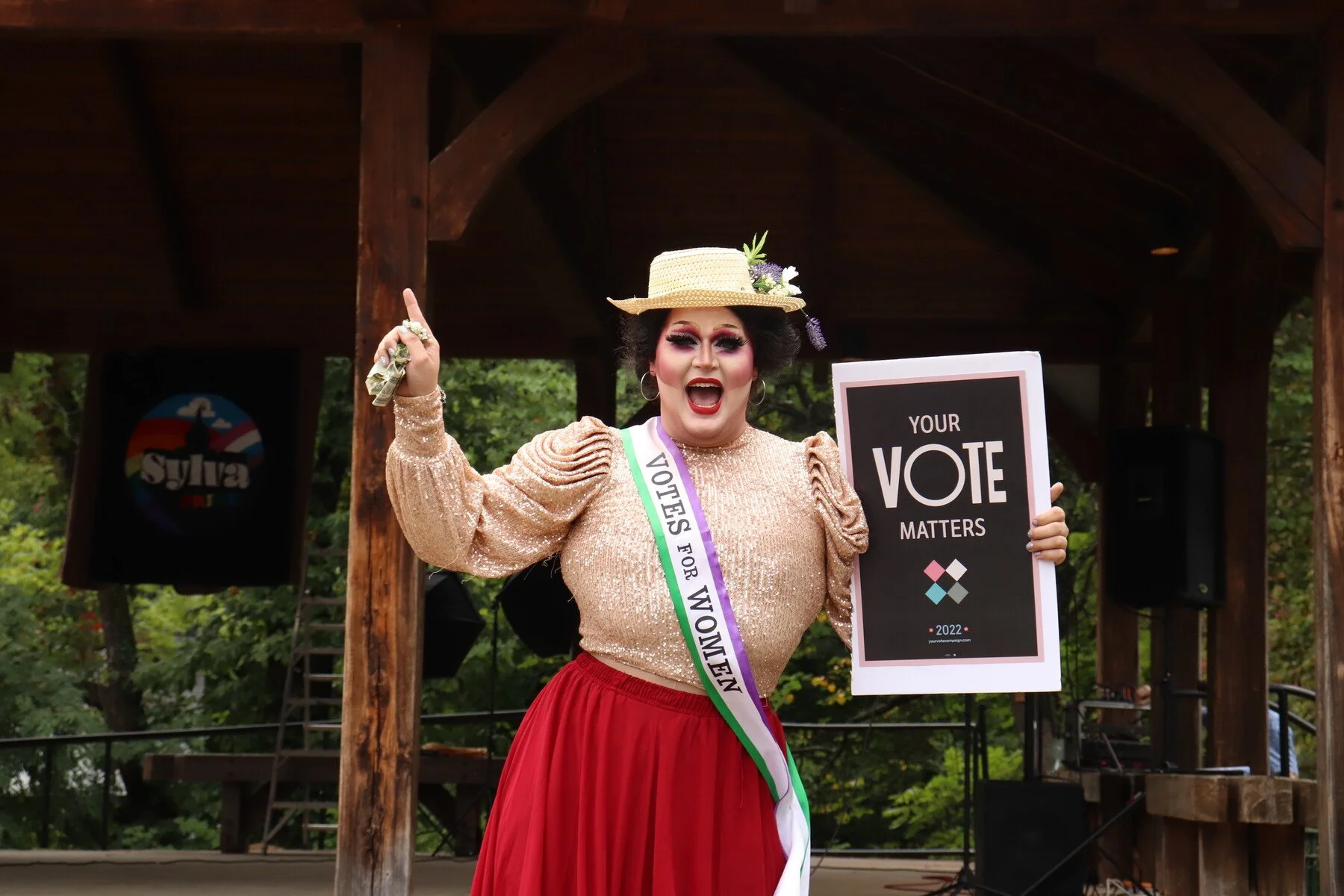
Drag queen Beulah Land, host of Sylva Pride, 2022. Courtesy of Southern Appalachian Digital Collections.
Many who grow up here express that Appalachia indeed has a way of pulling you home. Queer people living in Appalachia have to balance their identities with their safety and belonging, and thus, many in queer communities find themselves shedding their seal’s skin to walk amongst the broader Appalachian community.
[i] Jeff Mann,“Stonewall and Matewan: Some Thoughts on Gay Life in Appalachia,” Journal of Appalachian Studies 5, no. 2 (1999): 208.
[ii] Kate Black and Marc A. Rhorer, “Out in the Mountains: Exploring Lesbian and Gay Lives,” Journal of the Appalachian Studies Association 7 (1995): 25.
[iii] Jeff Mann, “Stonewall and Matewan: Some Thoughts on Gay Life in Appalachia,” Journal of Appalachian Studies 5, no. 2 (1999): 208.
[iv] Jeff Mann, “Stonewall and Matewan,” 209.
[v] Mary Anglin, “Aids in Appalachia: Medical Pathologies and the Problem of Identity,” Journal of Appalachian Studies 3, no. 2 (1997): 173.
[vi] Mary Anglin, “Aids in Appalachia,” 175.
[vii] Ibid., 179-180.
[viii] Carrissa Massey, “Appalachian Stereotypes: Cultural History, Gender, and Sexual Rhetoric,” Journal of Appalachian Studies 13, no. 1/2 (2007): 129.
[ix] Mary L. Gray, Out in the Country: Youth, Media, and Queer Visibility in Rural America. New York: New York University Press, 2009, 30.
[x] Mary L. Gray, Out in the Country, 38.
[xi] Mary Anglin, “Aids in Appalachia,” 178.
[xii] Ibid., 173.
[xiii] Kate Black and Mark A. Rhorer, “Out in the Mountains,” 22.
[xiv] Mary Anglin, “Aids in Appalachia,” 181.
[xv] Kate Black and Mark A. Rhorer, “Out in the Mountains,” 20-21.
[xvi] Mary L. Gray, Out in the Country, 59.
[xvii] Jeff Mann, “Negative Capability in the Mountain South,” in Queer South Rising: Voices of a Contested Place, ed. Reta Ugena Whitlock (Charlotte: Information Age Pub., 2013), 143.
[xviii] Jeff Mann, “Negative Capability in the Mountain South,” 143.