By Remy Cox
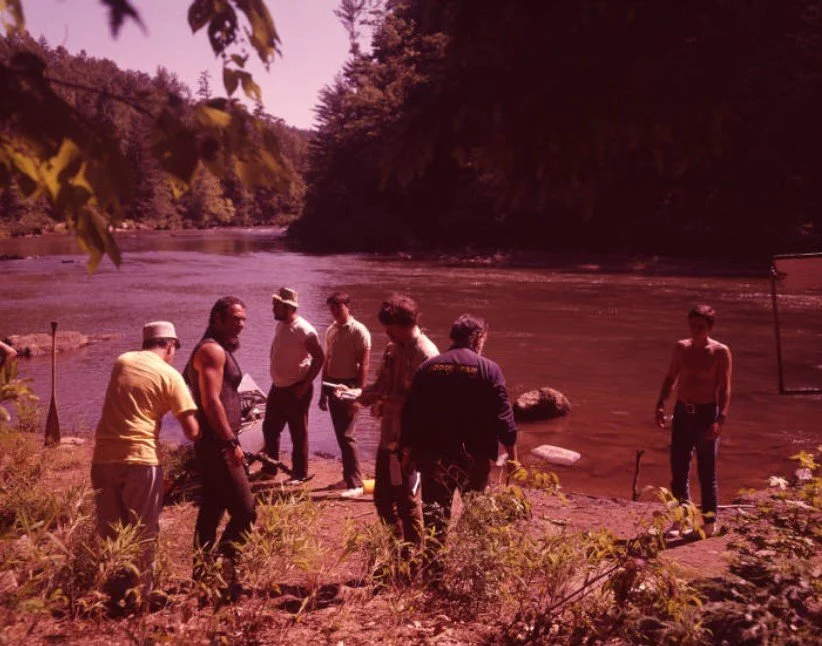
Behind the scenes of Deliverance. Copyright Atlanta Journal-Constitution. Courtesy of Georgia State University Library.
In 1972, director John Boorman’s film Deliverance hit screens across the country. Adapted from and written by Jame’s Dickey’s novel of the same name released two years earlier in 1970, the cultural impact of the film is hard to quantify. The film, which focuses on a group of four overconfident suburbanites taking an ill-advised and disastrous river trip, has been the source of many jovial warnings about boating on the Chattooga River.
Movies like Deliverance—that is to say, those that commodify and stereotype a certain group of people—often come to have a dual nature. Here, Appalachians become the hillbilly. These movies do admittedly bring a lot of money into regions. Deliverance has single-handedly created a strong tourist niche for Rabun County, Georgia, where much of it was filmed, and towns where some minor shots were filmed like Sylva, North Carolina, also get to claim its fame. This film brought money into a historically underrepresented region, even fifty years out from its premiere, and rafting companies even promote Deliverance-themed boat tours of the Chattooga. This tourist money is funneled into a historically underrepresented and historically impoverished region, and that at least is a good thing. Yet, Deliverance’s hillbilly—a violent, sexually deviant, and regressive figure—still looms over the region, shadowing over the people of rural Appalachia and still shaping the perceptions that some people might have of the people who live there.
What Boorman was seemingly trying to play as grotesque, Appalachian viewers might interpret as ordinary people doing their best despite limited resources—for example, one fleeting shot of an older woman with a disabled little girl, perhaps her mother or grandmother—might be intended as innocuous, but in context with the other depictions of Appalachians in the film, is seems less so. Is Boorman intentionally presenting these people as fundamentally grotesque and unnatural? Maybe not, but it’s hard to argue the contrary. Images like this are foreign to the protagonists of Deliverance but are achingly familiar for anyone who has called rural Appalachia home. The reputation of Deliverance has tended to loom over its featured actors as well, haunting their lives in the years to come. Billy Redden, the young actor who played Lonnie, the banjo savant who played Dueling Banjos across from guitarist Drew (Ronny Cox), was portrayed in the movie as inbred and dim-witted, defying expectations in displaying his mastery of his instrument, had trouble escaping this portrayal in his school days during and after filming.[i] In a 2017 article about Lonnie’s portrayal and of the understanding of disability in Deliverance, Anna Creadick writes about the Dillards, the writers of Dueling Banjos, who played fictional band the Darlings on The Andy Griffith Show, who are similarly portrayed to Lonnie—somehow disabled, but with immense musical talented. This is more innocuous, but Creadick writes that “…the logic is really still the same: that mountain people are unclean, uncivilized mouth-breathers whose magical mystical musical virtuosity is just a pleasant system of a more dangerous pathology.”[ii] Bill McKinney, who had his breakthrough in Deliverance, certainly is remembered by many as the “mountain man” who sexually assaults Bobby (Ned Beatty) after cornering Bobby and Ed (John Voight) in the woods, despite quickly dying after being impaled on one of Lewis’ (Burt Reynolds) arrows.
Deliverance can’t be un-made, and despite its shortcomings, there is much productive to discuss about the film still. Furthermore, maybe the negative connotations of the film weren’t intended, but that doesn’t stop it from having the impact it’s had. The hillbilly is still in many ways the dominant cultural representation of Appalachia, and while reductive and regressive, can be mostly harmless. However, in those other times, the more violent form of the hillbilly can be very harmful. Although Deliverance brought eyes and cash to Appalachia, it may have done more harm than is proportional to its financial gain. Deliverance is considered a great film, but many might also consider it a scar.